|
|
|
Pamela Collins, M.D., M.P.H.
Assistant Professor of Clinical Epidemiology and Clinical Psychiatry
Director, Interdepartmental Global Health Track, Mailman School of Public Health
|
 |
|
|
|
 |
|
|
 |
Dr. Collins’s research focuses on the mental health and psychosocial aspects of the AIDS epidemic in the United States and Sub-Saharan Africa. In the United States, her studies have addressed the HIV prevention needs of women with severe mental illness. Dr. Collins and colleagues developed and evaluated the HIV prevention curriculum, “Our Selves, Our Bodies, Our Realities” to help women reduce risky sexual encounters, thereby reducing their risk of HIV infection. Dr. Collins’ work also examines the contribution of social stigma related to mental illness and ethnicity to women’s HIV risk.
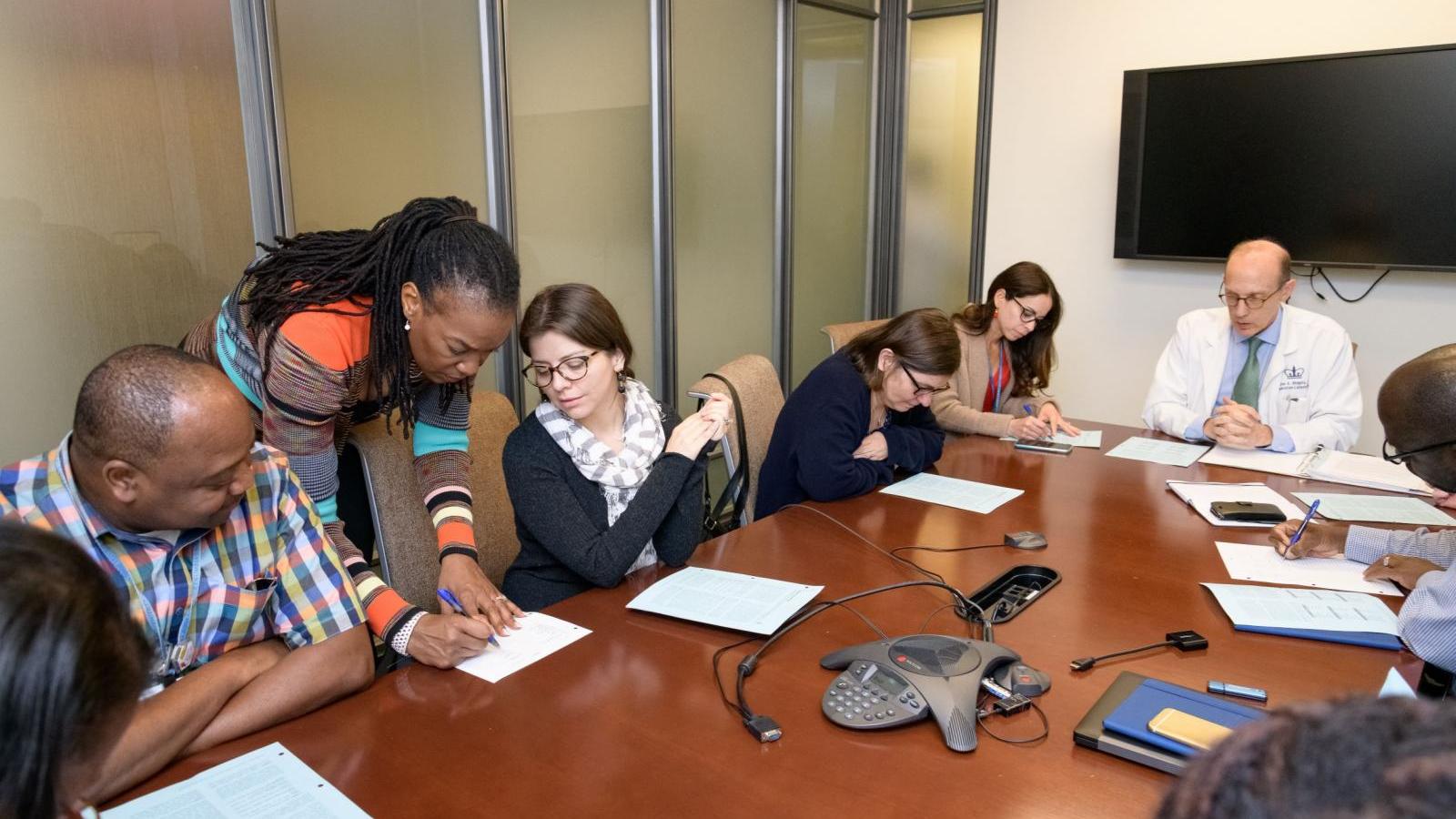
Dr. Collins has conducted training of health care providers in mental health and HIV/AIDS transmission, prevention, and counseling in Argentina, Zambia, Uganda, Rwanda, and South Africa. In South Africa, specifically, Dr. Collins’s work has examined the role of mental health care providers in development of HIV prevention interventions in psychiatric settings. She served as a consultant to the Directorate of Mental Health in South Africa and as a member of its Task Team for Policy Guidelines on HIV/AIDS in Psychiatric Institutions. Dr. Collins and her colleagues developed and evaluated an HIV education curriculum for South African mental health care providers, “Shosholoza for Health.”
Dr. Collins is a member of the mental health working group for the World Health Organization’s Access for All Initiative. She serves on advisory committees for a number of global mental health projects and organizations, including the Millennium Villages Project Mental Health Component and the Movement for Global Mental Health. She is the founder and director of the Society for Emotional Well-Being World-wide (www.seww.org).
In 2007, Dr. Collins was named an Office of Mental Health (OMH) Policy Scholar. Her study, “Cultural Competence and Mental Health Service Needs among African Diaspora Populations Living with HIV/AIDS”, explores mental health access for the populations served by African Services Committee, a Harlem-based organization.
|
 |
Undergraduate: Purdue University, B.A., 1986
Graduate: Columbia University School of Public Health, M.P.H., 1994-1997
Medical School: Cornell University Medical College, M.D., 1991
Internship: Lenox Hill Hospital, Internal Medicine, 1991 - 1992
Residency: Columbia PRESB/New York State Psychiatric Institute, PSYI, 1992 - 1995
Fellowship: Columbia University/New York State Psychiatric Institute, Schizophrenia Research Fellowship, 1995-1999
Board Certifications: American Board of Psychiatry and Neurology: 1996, 2006
|
 |
• HIV and Mental Health
• Mental Health Services in Low- and Middle-Income Settings
• Cross-cultural and Immigrant Mental Health
|
 |
Address:
Mailman School of Public Health Room 1713 Unit/Box: 722 West 168th St.
New York, NY 10032
Phone: 212-342-0446
pyc1@Columbia.edu
|
 |
| My research seeks to 1) understand how cultural context shapes behavior, emotional response, and the expression of mental illness, and 2) develop contextually relevant interventions locally and globally.

|
 |
1. Collins PY: Challenges to HIV prevention in psychiatric settings: Perceptions of South African mental health care providers. Social Science & Medicine 2006;63: 979-990
2. Collins PY, Holman A, Freeman M, Patel V: What is the relevance of mental health to HIV/AIDS care and treatment programs in developing countries? A systematic review. AIDS 2006;20: 1571-1582
3. Collins PY, Mestry K, Wainberg M, Nzama T, Lindegger G: Training South African mental health providers to talk about sex in the era of AIDS. Psychiatric Services 2006;57: 1644-1647
4. Freeman M, Patel V, Collins PY, Bertolote J: Integrating mental health in global initiatives for HIV/AIDS. British Journal of Psychiatry 2005;187: 1-3
5. Collins PY, Geller PA, Miller S, Toro P, Susser E: Ourselves, Our Bodies, Our Realities: An HIV preventive intervention for women with mental illness . Journal of Urban Health 2001;78: 162-175
|
 |
|
FACULTY ONLY


|
|
|